The state of Flock surveillance in Florida
By Joseph | 7 min read
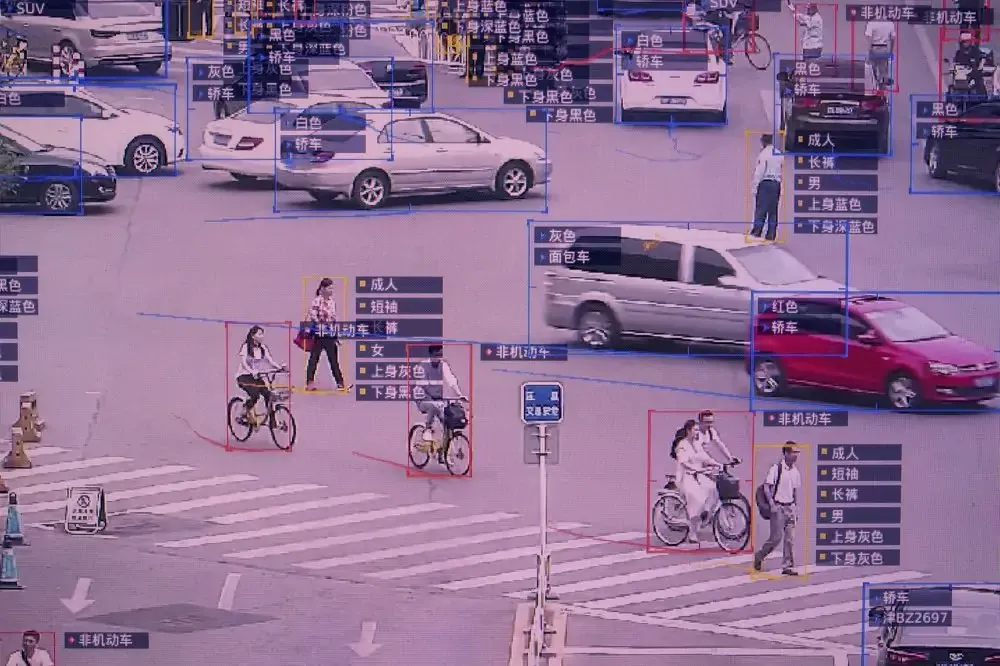
Image credit: Control iD
Have you ever seen a news segment about Chinese surveillance? The presenter will throw all kinds of facts at you, and as you hear them you will see people walking around with digital squares around their faces or around their cars. You can see that the government has detailed tracking on its population through cameras that are installed everywhere. At this point it's a news trope.
Well, it turns out we have that kind of system in the United States. What at one point was considered to be the quintessential picture of surveillance by America's greatest rival has now become a goal for many cities across the land of the free.
Introducing Flock Safety
While by no means the only player in this industry, Flock Safety is by far the company which has gotten the most attention for video surveillance in America in the last year.
Flock Safety contracts with law enforcement and private entities to provide security cameras to their clients.
But they're not just security cameras. The Electronic Frontier Foundation has compiled information on how automatic license plate readers (ALPRs) work, of which Flock is a vendor. Besides collecting the license plate and location of where a vehicle was spotted, ALPRs will also potentially capture images of the vehicle itself, of the driver or passengers, and attempts at making a "vehicle fingerprint" based on details such as "the vehicle's color, make, model, physical damage, and bumper stickers." Many if not all of these features can be found on Flock's own website.
As EFF explains, once this data is collected, it is stored in databases made accessible through hot lists. The policies for holding data can vary widely, in some case up to five years according to the EFF. Flock Safety says they only hold data for 30 days but this can vary by customer and what they stipulate in their contract. This data is then the basis for the hot list, where officers can be alerted when a particular vehicle of interest has been spotted. Flock elevates the idea of the hot list with their FreeForm product, which uses AI to allow a user to simply ask for details like "camo hat, forest green sweater" to find a match, as seen on their website.
One distinct offering by Flock is their national LPR network which allows law enforcement to share and access live feeds and access to their central database. Essentially, one agency could have access to license plate reads from across the country, including shared hot lists. While options exist for an agency to control how much data one agency may choose to contribute, the national lookup is a clear differentiator for why an agency would choose Flock over a competitor.
Lastly, there is Flock Nova, a tool to bring together all data an agency has access to as well as any data that Flock may be able to accumulate on the target of a search. While the product is pitched as a convenience tool that organizes information an organization may already have, it is the inclusion of personal information obtained through surveillance capitalism that tips this tool into an Orwellian nightmare. As Dr Jon Padfield of Business Reform shares, "imagine a police officer being able to search your location history, app usage, and online behavior across the entire United States, all without a warrant, just to see if you look suspicious."
In summary, Flock Safety provides a mass surveillance network for hire.
Mass surveillance is bad, actually
It shouldn't take much to understand the harms of mass surveillance, but for the sake of argument let's talk about what happens under authoritarian governments.
If you lived under a dictatorship where everyone had to do what the dictator said, and you disagreed with the dictator, you would face consequences by the government. If the dictator had an opinion over many facets of your life, that would equate to more areas in your life where you would need to align with the dictator. If there were safe places free from the watchful eye of the dictator, maybe you could be yourself. But what if the dictator could see your every move?
In the 21st century, it is possible for the government to obtain a detailed pattern of your life without a warrant, if enough Flock cameras are around. With tools like Flock, the government could hypothetically know where you live, where you work, what school you drop your kids off at, where you go to worship (or not), where you go for leisure, how often you are away from home, who else you spend your time with, and more.
And from that much more can be inferred, like what type of person you are. If you are frequently at a soccer field after stopping by a school that you visit every weekday, what does that say about you? If you've attended a rally or a political event, what does that say about you? If you are commuting over an hour to work and back, what does that say about you? All of these intimate details about your life that you might barely share to a loved one, let alone law enforcement, could be available to the government at any time, all tied together with a bow. This is the value proposition that Flock Safety is offering to the government.
We don't want to wait until a tyrannical government wants to start acting on the information they have. If you are an immigrant in the US, they are already acting on it.
Flock in Florida
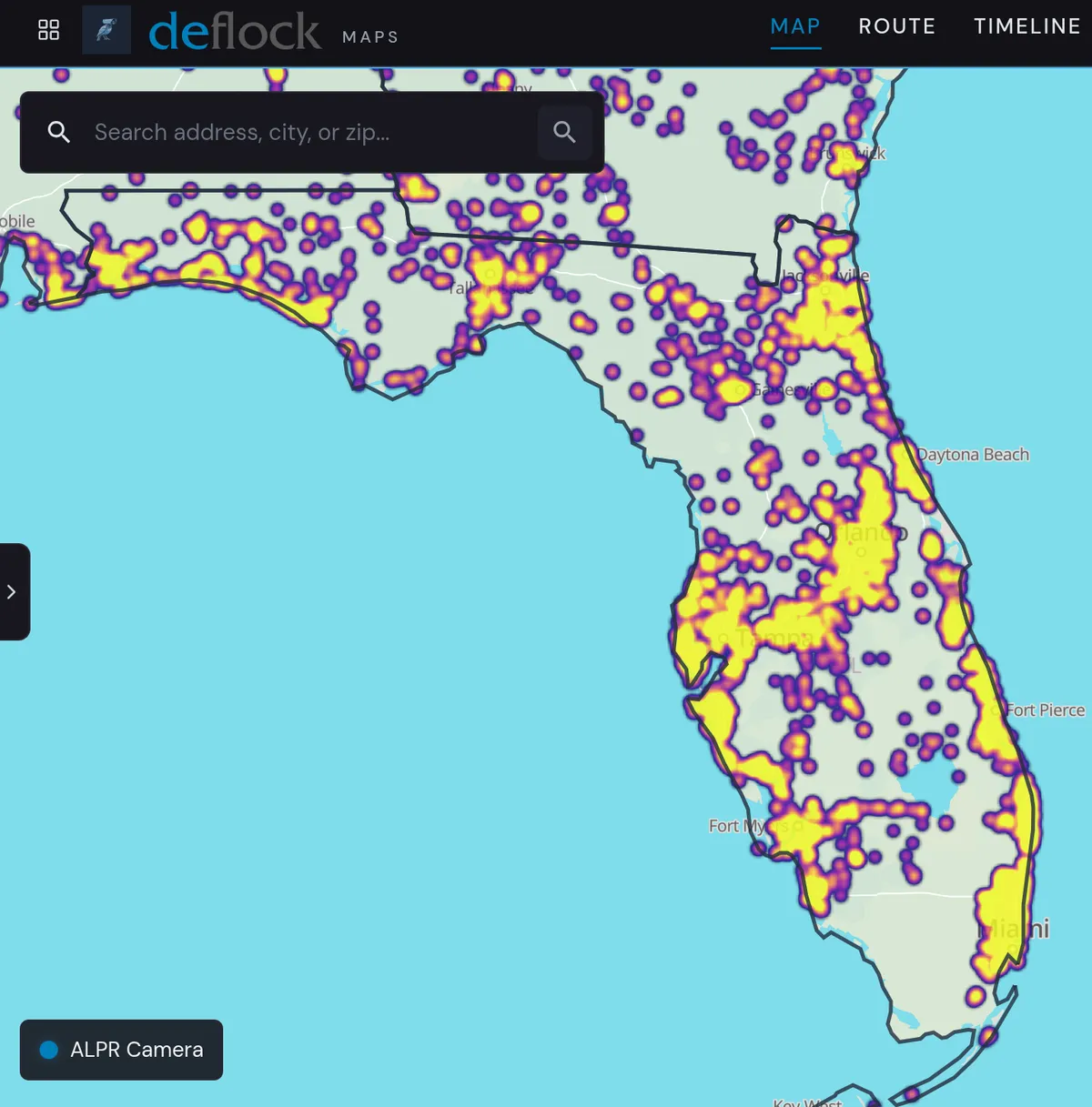
Thanks to the DeFlock Map which shows the crowdsourced locations of Flock cameras and other ALPRs (that we know of), we can see that there are over 100,000 cameras in the United States as of the date of publication. In Florida there are about 7,000 cameras. Let's see how many cameras there are in different regions of the state.
| Region | Est Number of Cameras |
|---|---|
| Panhandle (Pensacola, Tallahassee) | 1000 |
| Jacksonville | 500 |
| Gainesville | 200 |
| Volusia County (Daytona Beach) | 200 |
| Orlando | 500 |
| Lakeland and Winter Haven | 300 |
| Tampa Bay | 500 |
| Sarasota to Naples | 800 |
| Brevard County (Space Coast) | 200 |
| Palm Beach County | 300 |
| Broward County | 800 |
| Miami-Dade County | 300 |
These are cameras which are placed at key intersections, choke points, and similar locations which can collect information on passersby 24/7. Check out a popular intersection near you on the DeFlock map and see whether you are being tracked every time you pass by.
What is law enforcement doing with these cameras? They are definitely looking for immigrants, whether for themselves or on behalf of ICE. Florida Fish and Wildlife is also helping with ICE related searches. They are also used to track protesters, including at large protests like No Kings. Unfortunately there are a growing amount of cases in which officers across the country use their access to Flock to stalk current or former partners. Even in Florida an officer might "see a shiny thing" and proceed to track a woman's location for their own reasons. Not to be outdone, employees of Flock Safety will also use this access as they want, including accessing footage of a children's gymnasium for the purposes of sales calls.
As the mass deportation push by the Trump administration continues, more money is being set aside for ALPRs. Don't be surprised if more Flock cameras pop up in your neighborhood.
Our Position
At the Florida Digital Rights Association, our position is as follows:
- Contracts with ALPR vendors by the government must be cancelled.
- The cameras need to come down.
For the last decade and a half we have seen a build out of surveillance infrastructure through the growth of tech companies. All of it was in the name of providing beneficial products and services, and as we used these tools we were betrayed by them. Flock and companies like them represent a trend where the exploitation of regular people is the product, full stop. We as taxpayers pay for the privilege of being spied on by our own government.
We must stop building more surveillance infrastructure. The cameras need to come down.
If all of this is frustrating to you, consider taking action! There are several ways you can fight for a better future - one where technology works for us instead of against us.
- Plan to participate in DeFlock's National Week of Action on August 16-22, 2026.
- Join our Signal group chat to connect with others in Florida who are concerned about ALPRs and are helping each other fight back.
- See if there are people organizing in your area or consider starting your own local group. We have local chapters and are in touch with others who are organizing.
- You can also follow us on Bluesky or Mastodon for more updates and calls to action.
The fight against mass surveillance is not going to be easy, but if we want to live freely then it's going to take action. Please consider joining in.
Written by Joseph, Organizer
Enthusiast and advocate for digital privacy, cybersecurity, and free & open source software. Hobbyist. Wants to see the world get better.
Follow us on Bluesky and Mastodon. Share your thoughts on this blog post!